Global trade policy is rapidly transforming into a strategic instrument, evidenced by “The Greenland episode” and Canada’s notable pivot toward China.
This shift is creating a unique market environment where stable financial conditions coexist with increasingly turbulent commodity pricing, a divide set to define the near future, according to Rystad Energy’s Chief Economist, Claudio Galimberti.
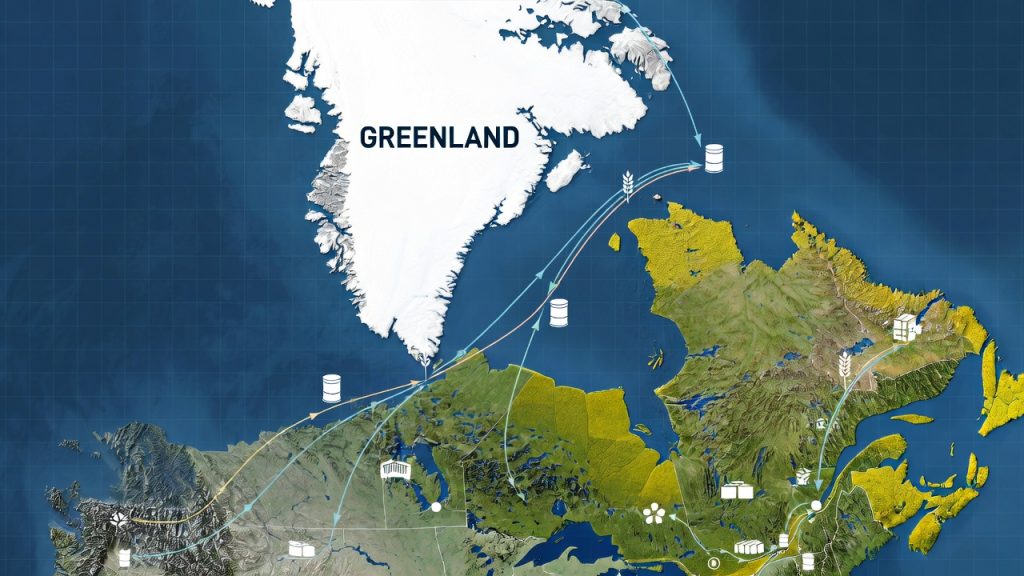
Greenland has unexpectedly become a flashpoint of tension between the United States and Europe.
Greenland flashpoint and Canada’s pivot to China
The escalating strategic significance Washington attaches to the island, driven by its military relevance, Arctic access, and substantial reserves of critical minerals and rare earths, has prompted a European response.
As a result, European nations, including Denmark, France, and Germany, have increased their military presence through coordinated Arctic exercises.
The threat of new tariffs by US President Donald Trump against Denmark and other European nations that object to US territorial claims could potentially raise the effective tariffs on the European Union up to 30%.
“Although no formal policy shift has yet been enacted, the episode has introduced new uncertainty into transatlantic trade relations and reinforced the growing overlap between trade policy and security objectives,” Galimberti said in Rystad Energy’s latest update.
Consequently, Canada has started to adjust its foreign trade policy.
This shift comes amid increasing tension between the US and its long-standing partners, with Prime Minister Mark Carney’s trip to Beijing signaling a symbolic improvement in the previously strained relationship.
The recently concluded trade agreement delivers a mixed outcome: a notable reduction in Chinese tariffs on Canadian canola products, providing immediate financial relief to western producers, is balanced against politically sensitive, albeit modest in volume, concessions on tariffs for Chinese electric vehicles entering Canada.
Crucially, the discussions have also served to reactivate channels for wider collaboration, including potential energy exports.
This renewed engagement comes as Ottawa is strategically evaluating its reliance on the US market in light of the evolving geopolitical landscape.
Macroeconomic context and financial market resilience
The ongoing macroeconomic strength, particularly in the US, forms the context for these developments.
Inflationary pressures stemming from the previous year’s tariff increases have subsided.
As of December, both headline and core inflation have stabilized at 2.7% and 2.6% year-on-year, respectively.
Consumer spending remains strong, driven primarily by higher-income consumers, and financial markets continue to anticipate a soft economic landing.
Galimberti said:
Notably, markets have remained largely indifferent to heightened political and institutional tensions, including the recent confrontation between the US administration and the Federal Reserve, with equity indices reaching new highs and volatility remaining subdued.
In Europe, Germany saw modest 2025 growth, aided by consumption and public spending after a two-year contraction, while the UK’s late-year activity rebounded strongly.
In Asia, China recorded a trade surplus high, redirecting exports despite weak domestic demand.
Japan, however, faces rising political and financial risks amid potential snap elections, currency weakness, inflation, and the Bank of Japan’s policy normalisation.
Commodity volatility against financial stability
Geopolitical risk is now predominantly transmitted through commodity markets.
“Oil prices have been volatile amid developments involving Iran and broader Middle East tensions, while gold and industrial metals have reached new highs as investors seek hedges against geopolitical uncertainty and supply-side risks,” Galimberti said.
Energy and metals markets are increasingly sensitive not only to physical supply and demand, but also to strategic trade measures, sanctions, and security-driven policy decisions.
Financial markets are generally optimistic about global growth, which is buoyed by resilient corporate earnings and sustained investment momentum, particularly within AI-related sectors, according to the analysis.
At the same time, the growing prominence of geo-economics suggests that volatility in commodity markets is likely to persist.
The post From Greenland to canola: how geopolitics is changing trade, commodity markets appeared first on Invezz